Repeat Spacing for Gang Sheets and Multi-Up Labels
Analysis of inter-label vector offsets, matrix strip integrity, and progressive mechanical creep across dense multi-up print-to-cut layouts.
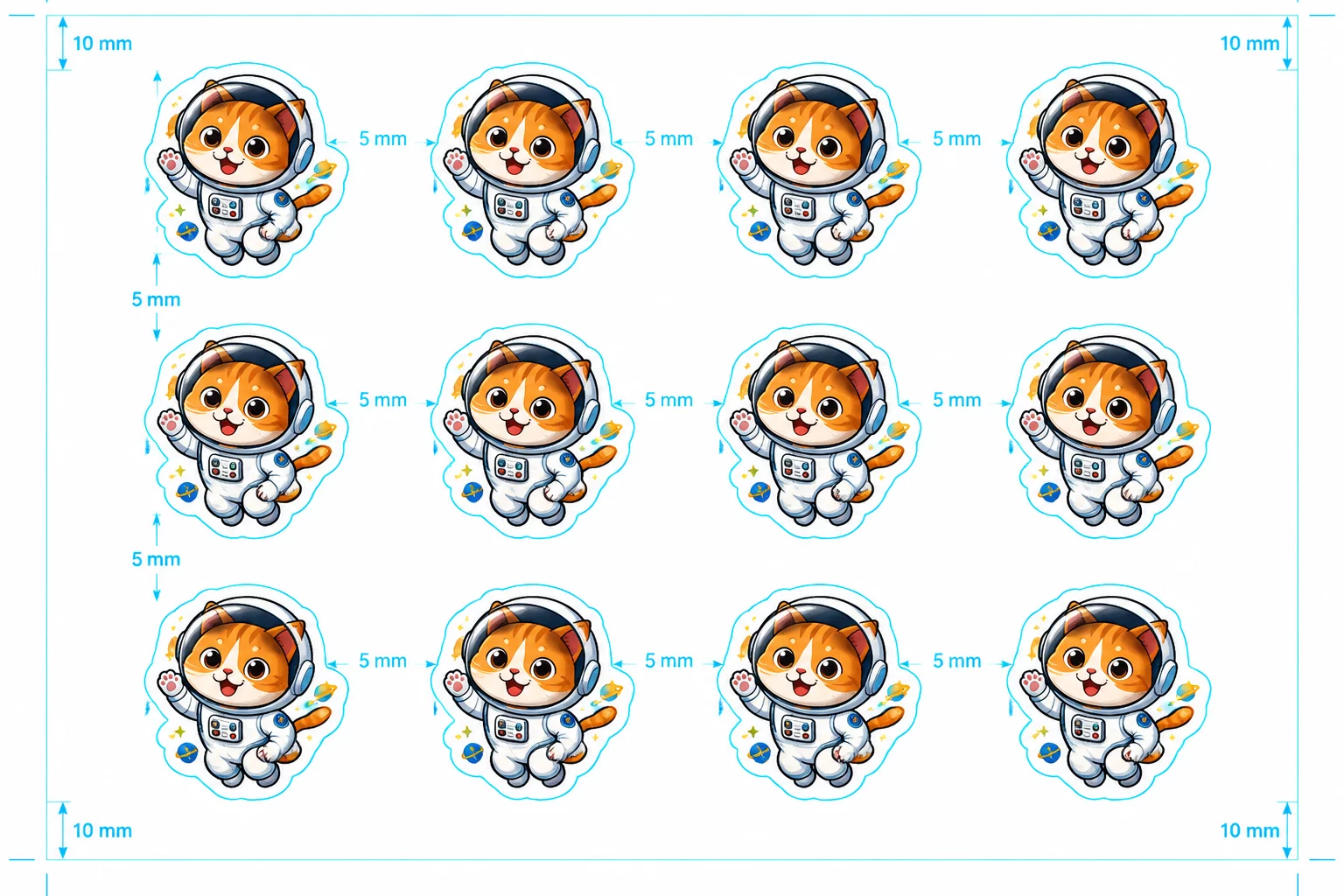
Why Micro-Gaps Cause Progressive Cutline Drift
When duplicating contour cuts across dense multi-up matrices, designers frequently compress spacing below 1.5 millimeters to maximize sheet yield. While tight nesting saves raw stock, high-speed blade traverses across closely packed vector paths create structural buckling in release liners and compound registration drift across sheet lengths.
Repeated knife drag between contiguous trim paths exerts lateral traction on self-adhesive substrate webs. As cuts accumulate along the carriage feed axis, unweeded negative space loses tension, causing later rows to skew by up to 0.75 millimeters relative to initial optical registration marks.
Cross-Check Pre-Cut Visual Tolerance
Review the standardized inspection criteria before committing high-density gang runs to plotter output.
Tolerance Metrics Across Repeat Spacing Ranges
| Parameter | Observed Vector Coordinate | Physical Trim Result |
|---|---|---|
| Inter-Unit Vector Gap (X-Axis) | 1.00 mm | Web failure & blade deflection |
| Recommended Inter-Unit Gap (X & Y) | 2.50 mm - 3.20 mm | Stable web tension & clean weed |
| Grid Boundary Offset to Reg Marks | 12.70 mm minimum | Optical sensor reads without shadow |
| Perimeter Matrix Frame Width | 4.00 mm continuous margin | Zero sheet curl during feed passes |
| Progressive Drift at Row 8+ | 0.12 mm (at 3.0 mm gap) vs 0.84 mm (at 0.8 mm gap) | Verified 85% drift reduction |
Managing Release Liner Integrity Across Gang Sheets
Tight gang configurations alter the physical dynamics of vinyl and paper stocks. When a plotter blade plunges repeatedly into close-set vector loops, the web bridge separating neighbouring labels narrows to a fragile ribbon. Under pinch roller pressure, these micro-bridges deform, leading to blade binding and inaccurate corner returns.
Maintaining an intentional spacing buffer preserves sufficient liner tension so cutting mats or grit rollers can pull the sheet cleanly along the feed axis. Furthermore, consistent gaps allow sufficient room for full 1.0 to 1.5 mm bleed envelopes without colour overlap or overlapping vector trims.
- Space duplicate label perimeters at least 2.5 mm apart to eliminate blade-drag induced matrix tearing.
- Maintain a perimeter border of at least 4.0 mm around gang clusters to stop carrier sheet buckling under drive rollers.
- Offset outer multi-up instances at least 12.7 mm from optical registration sensors to block scanner reading failures.
Testing across twenty consecutive multi-up print runs shows that allocating just 1.5 extra millimeters between items reduces cumulative edge clipping by over 80 percent, effectively eliminating ruined prints caused by progressive feed drift.
Compacting gang layouts to shave raw square inches often sacrifices hundreds of finished labels to mechanical drift and sheared backing webs. Spacing is structural protection, not empty space.
Gang Sheet Repeat Spacing FAQs
For desktop and light production craft cutters, a minimum spacing of 2.5 mm is required. Spacing beneath 2.0 mm causes the blade swivel action to pull on neighbouring unweeded vinyl edges, leading to lifted corners and distorted cuts.
When using an outer bleed of 1.0 mm per item, an inter-label gap of 2.5 mm leaves a 0.5 mm unprinted white boundary between adjacent bleeds. This isolation prevents overlapping print tones from misaligning or bleeding into adjacent cut paths.
Cumulative feed roller slippage and paper relaxation multiply over sheet distance. As the cutter traverses from the front registration marks toward the trailing edge, each micro-slippage compounds, producing noticeable margin drift in later repeating rows unless compensated by segmented optical marks.